
DOT
Truck chain laws by state: winter 2026–27 rules, fines and what fleets should do
November 21, 2026


Where trucks must carry chains vs mount them in CO, WA, CA, OR, NV and WY, the fines, and why a forecast storm won't earn extra driving hours.
By Alex Smith · Updated November 21, 2026
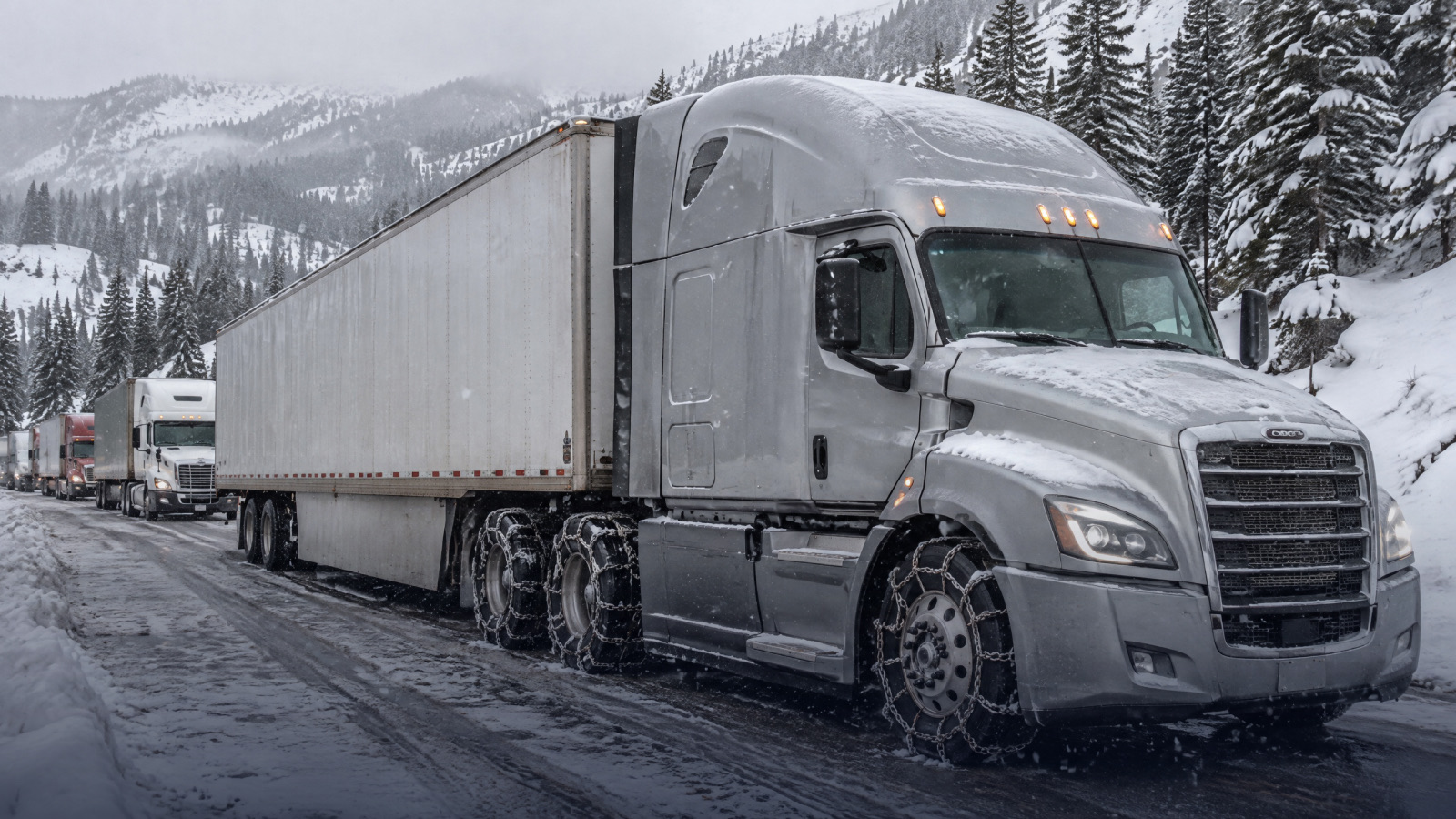
Truck chain laws are set by each state; there is no federal chain law. In the West, Colorado and Washington make heavy trucks carry chains on listed mountain routes all season, while California, Oregon, Nevada and Wyoming require chains once signs go up. Colorado's top fine is $1,000 plus a $157 surcharge for a truck stuck and blocking traffic.
As of November 21, 2026: the rules below were checked on each state's own pages today. Colorado's new chain-up assistance program is approved but not running yet.
This guide covers the six states where most chain tickets and closures hit trucks, the hours-of-service side of a storm, one clocked example and an owner checklist.
Chain laws at a glance: six western states
"Carry" means the chains must be in the truck on certain roads for the whole season, even on a dry day. "Mount" means the chains go on the tires when the state posts a requirement.
| State | Trucks covered | Carry rule | When chains go on | Fine (state source) |
|---|---|---|---|---|
| Colorado | Commercial vehicles over 16,000 lb combined weight | September 1–May 31 on seven mountain corridors named by the State Patrol (I-70 west of Morrison is one) | When the chain law is activated | Up to $500 + $79; stuck and blocking: $1,000 + $157 |
| Washington | Over 10,000 lb gross vehicle weight rating (GVWR) | November 1–April 1 on 12 routes named in the rule, such as I-90 between mileposts 32 and 101; plus two extra chains | When signs say chains are required | Not stated on the state pages we checked |
| California | Heavy-duty vehicles over 6,500 lb | No set dates | Whenever chain controls are posted; snow tires don't exempt trucks | Not stated on the Caltrans page |
| Oregon | Commercial vehicles over 10,000 lb gross vehicle weight (GVW) | Whenever conditions might call for chains or Snow Zone signs are posted | When signs require chains | $880 for a truck that fails to use chains |
| Nevada | Over 10,000 lb GVW | No set dates | When chain or snow-tire requirements are in place | Not stated on the state page |
| Wyoming | Commercial vehicles | No set dates | Level 2 restriction: two drive wheels on one drive axle | $250; $750 if it leads to a closure |
Sources: Colorado State Patrol, WAC 204-24-050, Caltrans, Oregon Department of Transportation, Nevada Department of Transportation, Wyoming Department of Transportation.
Watch out: some guides cap chain tickets at $500. That's too low for the West: Oregon's truck fine is $880, and a blocked lane in Colorado costs $1,157 with the surcharge.
Carry rules vs chain-up rules
The two rules are easy to mix up. In Colorado and Washington, a truck with no chains can break the law on a sunny afternoon, because the season, not the weather, triggers the carry rule.
Colorado. Commercial vehicles must carry chains from September 1 through May 31 on I-70 from milepost 259 westward, Colorado 9 from Frisco to Fairplay, US 40 west of Empire, US 50 west of Salida, US 160 west of Walsenburg, US 285 from Morrison to the New Mexico line and all of US 550. The State Patrol lists what counts for a combination:
- "4 tire chains, 4 AutoSocks", or auto chains or sanders;
- on tandem drive axles, 2 chains plus 2 cables at least 0.415 inches thick;
- on a single drive axle, no cables at all.
A hotshot pickup pulling a trailer over the weight line carries 2 chains, or 4 if it's a dually (State Patrol chain law page).
Washington. On the 12 routes in WAC 204-24-050, trucks over 10,000 lb GVWR keep chains aboard between November 1 and April 1. When chains go on, a single drive axle gets one chained tire on each side, a tandem tractor chains one drive axle the same way, and the trailer gets one chained tire on its last axle. Every truck in this class also carries two extra chains.
One detail to know: the Washington State Department of Transportation (WSDOT) mountain-pass page gives the carry window as "Nov. 1 to March 31", one day shorter than the rule. We follow the rule's April 1 date, and so should your drivers.
California. There's no carry season. When chain controls are posted, trucks over 6,500 lb must have chains on to continue, and any braked trailer must have one axle chained. Caltrans can also set up truck screening checkpoints on mountain approaches, and trucks without chains "will be directed to return to a lower elevation" until the weather improves.
Oregon, Nevada and Wyoming work like California: the requirement turns on with the signs. Oregon still expects commercial vehicles over 10,000 lb to have chains aboard whenever conditions might call for them.
What's new this winter in Colorado
Colorado is enforcing the carry rule early. The State Patrol held its first two chain checks of the season on October 23 and 28 near Dotsero. Troopers stopped 703 commercial vehicles and cited 63 drivers for not carrying chains. That's about 91% in compliance, as Summit Daily reported from a Patrol release. The Patrol schedules these checks on mild days, so a clear forecast doesn't mean no check.
Help with chaining up is on the way, but not yet. The Colorado Transportation Commission approved a program that lets private companies help truckers install chains at I-70 chain stations, one company per station. The Colorado Department of Transportation (CDOT) told the Post Independent on November 20 that the first permits will likely come after the holidays, possibly in early 2027. Prices are still being set. For December, plan on your drivers doing it themselves.
The federal side: 49 CFR 392.14 and your hours
No federal rule tells you when to chain up. Two federal rules still apply on every snowy pass.
Extreme caution. 49 CFR 392.14 requires reduced speed in snow and ice. If conditions become "sufficiently dangerous", the driver must stop and stay stopped until the truck can be operated safely.
Hours of service (HOS). The adverse driving conditions exception adds up to 2 hours of driving and 2 hours to the 14-hour window (49 CFR 395.1(b)(1)). Three limits matter in winter:
- A known storm doesn't count. The Federal Motor Carrier Safety Administration (FMCSA) covers this in its guidance. A driver sent out after the carrier "has been notified or should have known" of the conditions doesn't qualify (FMCSA guidance). A storm in yesterday's forecast is something the office should have known.
- Only the time lost counts. If the closure cost one hour, the driver gets one hour (FMCSA FAQ).
- The driver annotates the log. The electronic logging device (ELD) record must explain the exception (FMCSA FAQ). If the officer can show there was no adverse condition, the driver is cited for the hours violation.
Our full guide to the adverse driving conditions exception has more cases, and the basic limits are in our hours of service rules post.
Example: one truck, one I-70 storm
A six-truck fleet sends a driver from Denver to Grand Junction on Tuesday, December 15, 2026. The driver came on duty at 5:00 a.m. for a morning drop in Denver, so their 14-hour window ends at 7:00 p.m. The run west was planned at about 6 hours of driving plus a 30-minute break, arriving around 5:30 p.m.
| Time | What happens |
|---|---|
| 11:00 a.m. | Leaves Denver westbound on I-70 |
| 12:10 p.m. | Chain law activated; 40 minutes at the chain station to mount chains |
| 1:30 p.m. | Vail Pass closed after a spinout; 1 hour 20 minutes waiting |
| 7:00 p.m. | 14th hour since 5:00 a.m.; the receiver is still about 30 minutes away |
The storm cost 2 hours, which moves arrival to about 7:30 p.m. What happens next depends on one question: did the office know?
- Version A: snow was in the forecast the night before. The office dispatched into a known storm, so the exception doesn't apply. The driver must stop at a safe place by 7:00 p.m., take 10 hours off and deliver the next morning.
- Version B: a squall nobody forecast. The driver may extend by the time the storm actually cost. Even counting only the 1 hour 20 minute closure, the window runs to 8:20 p.m. They deliver at 7:30 p.m. and note the storm and the closure on their log.
Now take the chains out of the truck. On this stretch of I-70 the driver is breaking Colorado's carry rule from the moment they pass Morrison, storm or not. If the truck then spins out and blocks a lane, the citation alone can reach $1,157, before the cost of the lost day.
Owner checklist before the first storm
- Count chains per truck by state. A combination on Colorado corridors needs a set of 4 tire chains or an approved alternative. In Washington, carry enough to meet the placement rule plus 2 extras.
- Check the chains, not only the box. Look for broken cross links and missing hooks during the pre-trip inspection, and replace them before December.
- Make chain-up part of driver onboarding. CDOT's own staff say trucks pull into chain stations without chains or without knowing how to fit them. Have every new driver mount a set once in your yard.
- Read the forecast before dispatch, and write down what you saw. A known storm removes the extra 2 hours, so plan mountain loads with time left in the 14-hour window.
- Give one person the road-condition check. Use each state DOT's official road-condition map, such as TripCheck in Oregon or WSDOT's mountain pass reports, and check it again before the climb.
- Pick safe parking short of each pass. When §392.14 says stop, the driver needs somewhere legal to wait.
- Re-plan from the driver's real hours. In Motion Fleet (Motion ELD), the office sees each driver's available hours and HOS violations. A dispatcher can then tell whether a closure still leaves time to reach the receiver.
For what inspectors check in the cab once a truck is pulled in, see our guide to ELD violations and fines.
FAQ
Is there a federal chain law for trucks?
No. FMCSA doesn't set chain rules; each state writes and enforces its own. The federal rule that does apply is 49 CFR 392.14. It requires extreme caution and lower speed in snow and ice, and it says the driver must stop if conditions become too dangerous. State chain requirements sit on top of that rule.
Do I have to carry chains in Colorado if it isn't snowing?
Yes, on the listed corridors. From September 1 through May 31, commercial vehicles over 16,000 lb must carry chains or an approved alternative on roads such as I-70 west of Morrison, whatever the weather. The State Patrol runs carry checks on mild days and cited 63 drivers at its first two checks this season.
When do trucks have to carry chains in Washington?
WAC 204-24-050 requires vehicles over 10,000 lb GVWR to keep chains aboard between November 1 and April 1 on 12 routes the rule names. I-90 between North Bend and Ellensburg is one of them. They must also carry two extra chains. WSDOT's travel page says March 31, so follow the rule's April 1 date to be safe.
Do snow tires exempt a semi from chain controls in California?
No. Caltrans says there is no exemption for heavy-duty commercial vehicles over 6,500 lb with snow tires. When chain controls are posted, chains must be mounted to continue, and trailers with brakes get chains on one axle or more. Trucks without chains at a screening point are sent back to lower elevation.
Does a chain-control closure give me extra driving hours?
Only if nobody could have known about it at dispatch. Under the adverse driving conditions exception, a driver can get up to 2 more hours of driving and window time, but only the time actually lost. A storm already in the forecast when the load was dispatched doesn't qualify, and the driver must annotate the ELD record.
Questions about logs, hours or tracking for your trucks this winter? Talk to the Motion Fleet team.
Sources
State rules and 49 CFR 392.14 checked November 21, 2026; FMCSA hours-of-service guidance checked November 16, 2026. This page is reviewed every year before winter.
- Colorado State Patrol, "Colorado State Patrol Wants Commercial Drivers to Be Prepared for Winter Weather" (October 21, 2026)
- Colorado State Patrol, Colorado Chain Law Information
- Caltrans, Truck Chain Requirements
- Washington Administrative Code 204-24-050
- WSDOT, Tires & chains
- Oregon DOT, Tips for Commercial Vehicle Drivers
- Nevada DOT, Traction and Chains Requirement Descriptions
- Wyoming DOT, Chain law
- 49 CFR 392.14
- 49 CFR 395.1(b)(1) and 395.2
- FMCSA guidance on the adverse driving conditions exception and dispatch
- FMCSA HOS FAQs: extra time allowed in adverse conditions and annotating the ELD record
- Summit Daily, State Patrol chain-check results (November 16, 2026)
- Post Independent, CDOT chain-up assistance program (November 20, 2026)
What's next
Security
November 24, 2026
Cargo theft prevention for the 2026 holidays: a plan for small fleets
Fewer thefts, bigger losses: the 2026 holiday risk dates, an office checklist for fake pickups and hijacked carrier IDs, and who to call first.
IFTA
November 18, 2026
How to calculate IFTA miles and tax by state (with a worked example)
The IFTA formula with the return's rounding rules, one truck's quarter worked through with credits and a surcharge, and the trip records auditors accept.
ELD
November 17, 2026
ELD Violations and Fines: 2026 Penalties and CSA Points
The common ELD violations, their CSA severity weights, 2026 fines up to $15,846, and how long one inspection stays on your record. With an owner checklist.